Week 12
- Dec 10, 2015
- 3 min read
Sonic Logs
Sonic logging is a well logging tool that provides a formation's interval transit time, which is a measure of a formation's capacity to transmit seismic waves.
It is used for:
1) Determine porosity of reservoir rock
2) Improve correlation and interpretation of seismic records
3) Identify zones with abnormally high pressures
4) Assist in identifying lithology
5) Estimate secondary pore space
6) Indicate mechanical integrity of reservoir rocks and formations that
surround them (in conjunction with density data)
7) Estimate rock permeability
For its mechanism, sonic tools measure the traveltime (Δt) of a compressional, P, wave as it travels through a formation, they can also measure shear, S, velocity, which is useful in understanding rock mechanical properties.
Errors can occur in sonic logs if the formation is unconsolidated, in fractured formations, or if the transmitter and/or receiver are poor.
Another issue is that sonic ignores secondary porosity; i.e, vugs and fractures.

Resistivity Log
Resistivity logs measure the ability of rocks to conduct electrical current and are scaled in units of ohm-meters.
There is a wide variety of resistivity tool designs, but a major difference between them lies in their "depth of investigation" and their "vertical resolution".
Usually while drilling, drilling fluids invade the formation, changes in the resistivity are measured by the tool in the invaded zone.
For this reason, several resistivity tools with different investigation lengths are used to measure the formation resistivity. If water based mud is used and oil is displaced, "deeper" resistivity logs (or those of the "virgin zone") will show lower conductivity than the invaded zone.
If oil based mud is used and water is displaced, deeper logs will show higher conductivity than the invaded zone.
This provides not only an indication of the fluids present, but also, at least qualitatively, whether the formation is permeable or not.
The difference between the resistivity log measurements and the invasion process is clear in the resistivity logs. The separation between the curves on the log can be seen in the more porous and permeable sandstones, but minimal separation is found in the shales which are effectively impermeable.
Induction Log
These were developed to measure formation resistivities in boreholes containing oil-based muds and in air-drilled boreholes because electrode devices could not work in these nonconductive boreholes.
Its biggest advantage apart from that is that the tools are easy to run and require much less in the way of chart corrections.
Conventional induction logs measure conductivity perpendicular to the axis of the tool.
The mechanism of the tools is as follows:
The tools are made up of coil arrays designed to optimize vertical resolution and depth of investigation.
The induction transmitter coil is driven by an alternating current that creates a primary magnetic field around the transmitter coil. The primary magnetic field causes eddy currents to flow in a continuous circular distribution, centered around the borehole axis.
These eddy currents are proportional to the formation conductivity.
Both induction and galvanic sondes can be designed to obtain different depths of investigation into the formation.
The induction log is generally recommended for holes drilled with only moderately conductive drilling muds or nonconductive muds (e.g., oil-based mud (OBM)) and for empty or air-drilled holes.
Induction tools are conductivity-sensitive devices, which are most accurate in low- to medium-resistivity formations.
Caliper Log
These are among the simplest and most accurate measurement tools for the inside condition of pipe. They are principally used to evaluate wear and corrosion.
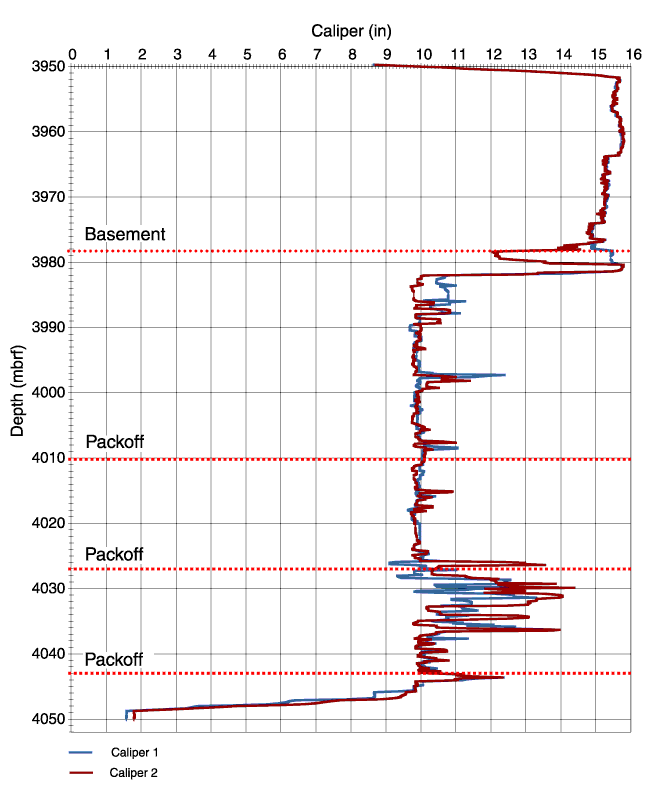
The log is a representation of the measured diameter of a borehole along its depth.
Since wellbores are usually irregular (rugose), it is important to have a tool that measures diameter at several different locations simultaneously.
A caliper may also be used to center or eccenter a tool string.
Single sensor calipers measure one diameter of the hole and are combinable with all open-hole logging instruments.
In general, caliper logging tools can be grouped into two major categories:
(1) Multifinger Tubular Inspection Calipers, and
(2) Conventional Calipers
Some other caliper applications include:
1. Evaluation of scale build up.
2. Evaluation of well shots (high explosives shots and propellant shots).
3. Determination of optimal locations to seat packers (as in well testing).
4. Determination of optimal directional drilling kick-off points.
5. Location of parted or collapsed casing.
6. Correction of various flow profile logs (and many open hole logs).
7. Determination of gravel volumes for gravel pack jobs.
8. Evaluation of acid jobs in open hole (before and after surveys).
9. Evaluation of hole conditions prior to fishing.
10. Demonstration of bit gauge compliance.
11. Location of liners and casing size reductions.
12. Determination of optimal perforation points.
13. Determination of cement volumes for well construction or plugging

Here is an example of a Caliper log:
Comments