Week 7
- Nov 6, 2015
- 2 min read

The topic of geological time was covered during this week. This topic is really important to people studying geology in general and to those in the oil and gas field in particular.
The geological time scale is a measurement system that related the earth’s strata to different periods in earth’s history.
It includes particular color codes, names, and dates that are all standardized by the International Commission on Stratigraphy.
The earth is as old as 4.5 billion years. During this long time it passed through many events that changed its composition and appearance.

There are particular principles that were set down for the creation of such time scales by Nicholas Steno in the late 17th century. The first one was the law of superposition, which assumed that any layer of the strata was older than the ones above it and younger than the ones below it. The second one was that the strata were always laid down in succession.
Both of these principles proved to not be very accurate as geologists discovered that sequences were eroded, distorted, tilted, or even inverted sometimes, and that rock layers from similar times in history could look very dissimilar in different places due to the contribution of other environmental factors.
Geologic time is divided into:
Eons
Eras
Periods
Epochs
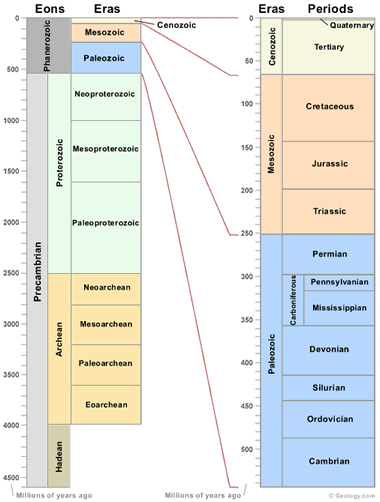
Previously, the exact time the earth was formed could not be known, so relative dating was used to show how long ago rocks were formed. Now that we do have that information, relative dating is still used albeit side by side with absolute dating.
As discussed previously, there are some rules to the creation of time scales, which are used till now by geologists:
The law of superposition
The principle of original horizontality
The principle of Cross-Cutting Relationships
Inclusions
Lateral continuity
Fossils succession
The Law of Superposition
It states that
The Principle of Original Horizontality
According to this principle
Lateral Continuity
It means
The Principle of Cross-Cutting Relationships
This principle
Inclusion
Inclusions are
Sometimes the earth’s history is also graphically represented as a spiral, as shown in the image below.

There are many methods nowadays to estimate the age of the earth. However one of the most powerful is the radiometric dating.
In radiometric dating, the process of the radioactive decay of naturally occurring isotopes in rocks is used to estimate the age of formations. Radiometric dating of rocks tells how much time has passed since some event occurred. For igneous rocks the event is usually its cooling and hardening from magma or lava. For some other materials, the event is the end of a metamorphic heating event, the uncovering of a surface by the scraping action of a glacier, or the length of time a plant or animal has been dead (the age of fossils).
The following graphics summarize how radiometric dating works:


Device like the one shown below (Magnetic sector mass spectrometer) are used in radiometric dating.

Comments