Week 6
- Nov 5, 2015
- 2 min read
In week 6, the formation of sedimentary rocks and depositional environment were discussed. Sedimentary rocks are called so from the Latin sedimentum , settling.

Sedimentary rocks make up only 5% (by volume) of the upper 10 miles of the crust, but about 75% of the outcrops on the continents.
Two primary types of sedimentary rocks:
Chemical - precipitate from solution (e.g., limestone); most important constituents are calcite, dolomite, chalcedony (SiO2), gypsum, and halite. Chemical sedimentary rocks can be further divided as to:
inorganic (e.g., limestone, rock salt, dolomite)
organic (e.g., limestone or coal).
Detrital, or clastic - detritus, or fragments, of other rocks (e.g., sandstone); the most important constituents are quartz, calcite, clay minerals (from the weathering of feldspars), rock fragments, and feldspars. They are composed of:
clasts: the larger grains
matrix: the finer-grained material surrounding the clasts
cement: the material that binds the clasts and matrix together. Common cements include iron oxide, calcite, and silica.
Sediments become rocks by lithification. Compaction is the process by which sediments form sedimentary rock.
compaction - lithification occurs as the weight of overlying sediments and rocks squeeze the sediments together into rock.
cementation - precipitates from groundwater and the growth of secondary minerals between the fragments may cement the rock.
recrystallization - minerals may reform or change owing to burial pressure and temperatures - does not necessarily make the rock metamorphic.
Facies: mass of sedimentary rock that can be defined and distinguished from the surrounding rock based on its geometry, lithology, sedimentary structures, paleocurrent pattern, or fossils.
Sedimentary rock has layers of sediments that are arranged according to their density. Sedimentary rocks are extremely important resources that give us clues about the Earth's past.
Examples of organic sedimentary rock include limestone and coal.
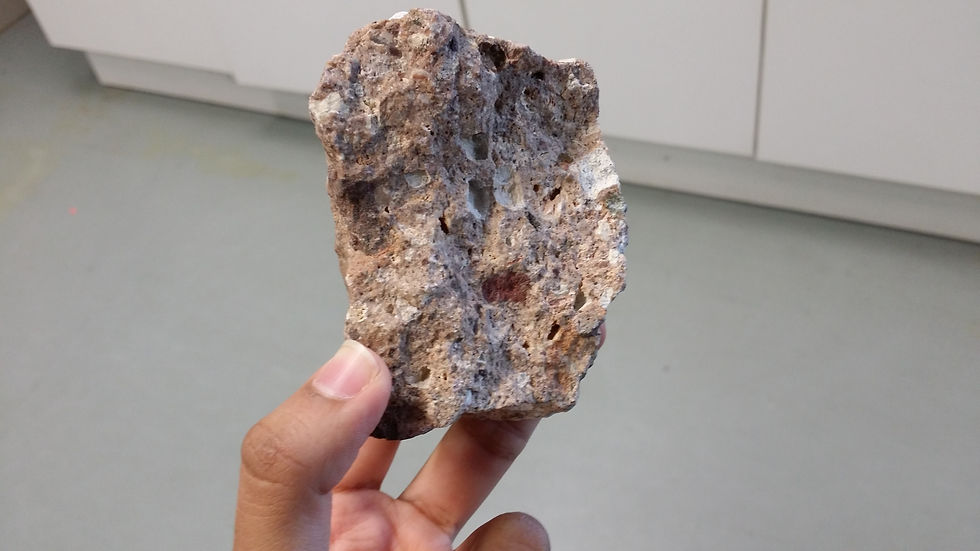
This week also included an accompanying lab session which helped us understand the material in a better way. The lab required us to observe several samples of igneous rocks and to describe their properties, such as chemical composition, magma type, main type of minerals, as well as whether they were intrusive or extrusive.
(The following images are my own snapshots).



Comments